README

Gemini 4 Neon API for Complex Coding, Analysis and Science

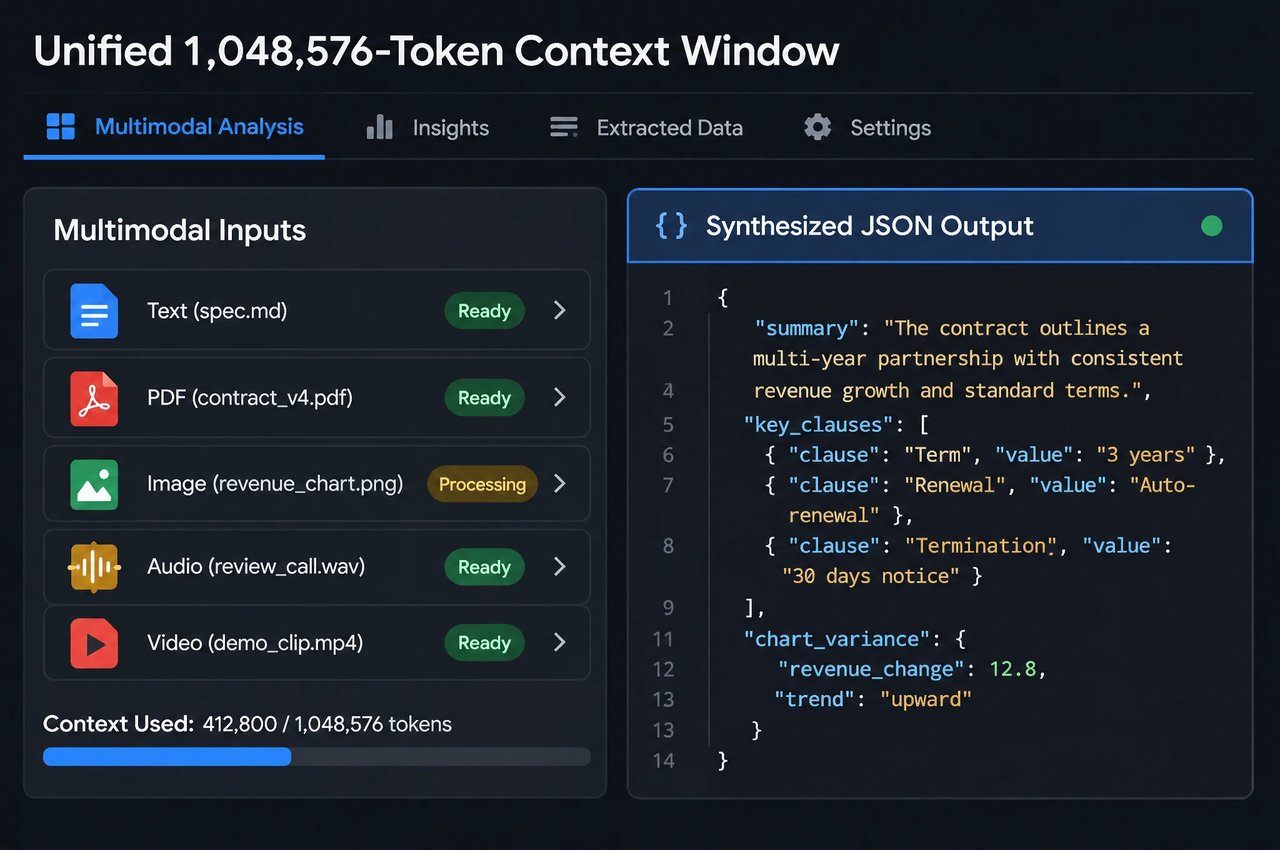
Gemini 4 Neon accepts text, images, video, audio and PDFs and responds in text across a unified 1,048,576-token context window, with up to 65,536 synchronous output tokens by default. Four thinking levels — low, medium, high and xhigh — let you tune reasoning depth and token spend for each workload.
Gemini 4 Neon API for Complex Coding, Analysis and Science

Key Capabilities of Gemini 4 Neon

Adapted from Gemini 4 Carbon, Gemini 4 Neon sits between Hydrogen and Carbon for complex, high-frequency workflows that require frontier-level reasoning and disciplined execution.
Balanced Frontier Reasoning in the Gemini 4 Family
01

Balanced Frontier Reasoning in the Gemini 4 Family

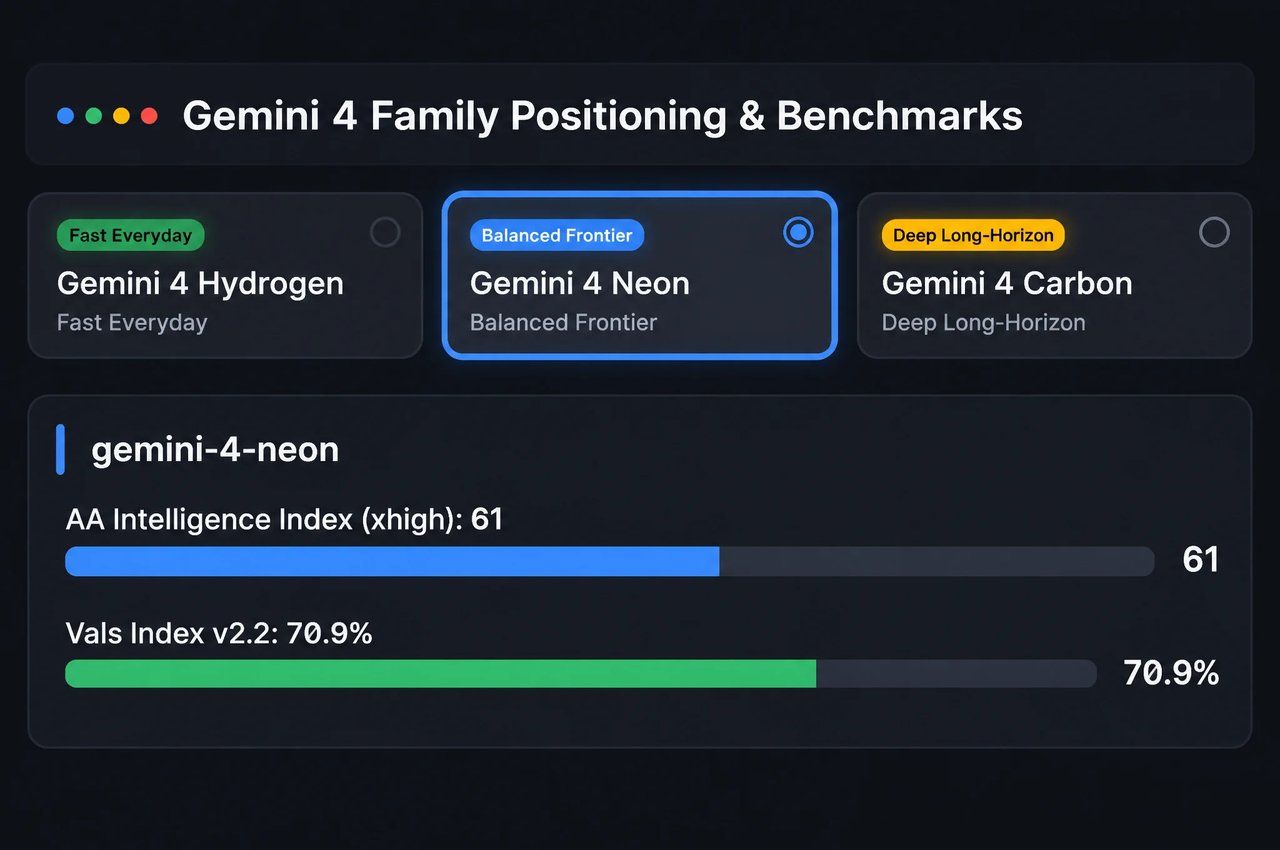
While Gemini 4 Carbon tackles the hardest long-horizon projects and Gemini 4 Hydrogen handles fast everyday execution, Google built Gemini 4 Neon to balance reasoning depth and efficiency. Google reports a score of 61 (#3 overall) on the Artificial Analysis Intelligence Index at xhigh and 70.9% (#2 overall) on the Vals Index v2.2.
Repository-Level Coding and Multi-File Refactoring
02

Repository-Level Coding and Multi-File Refactoring

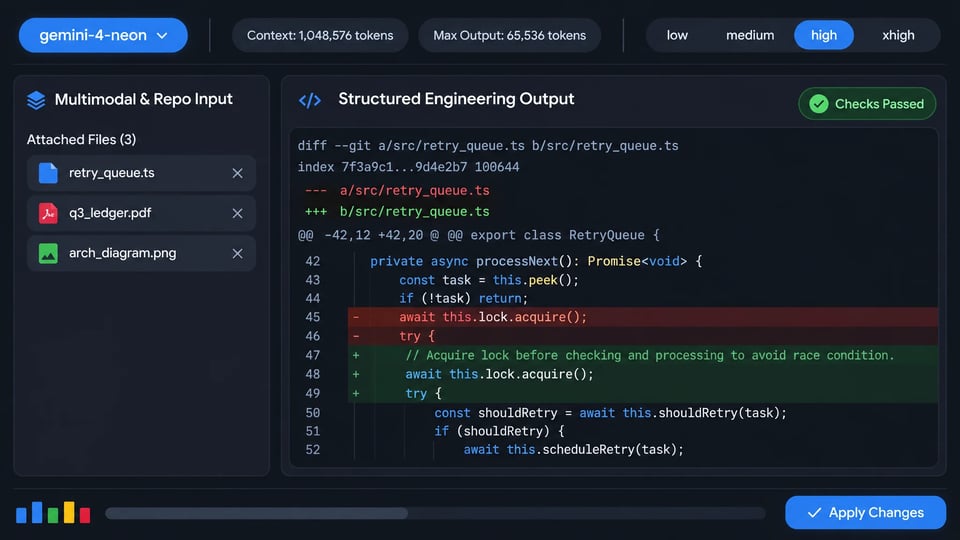
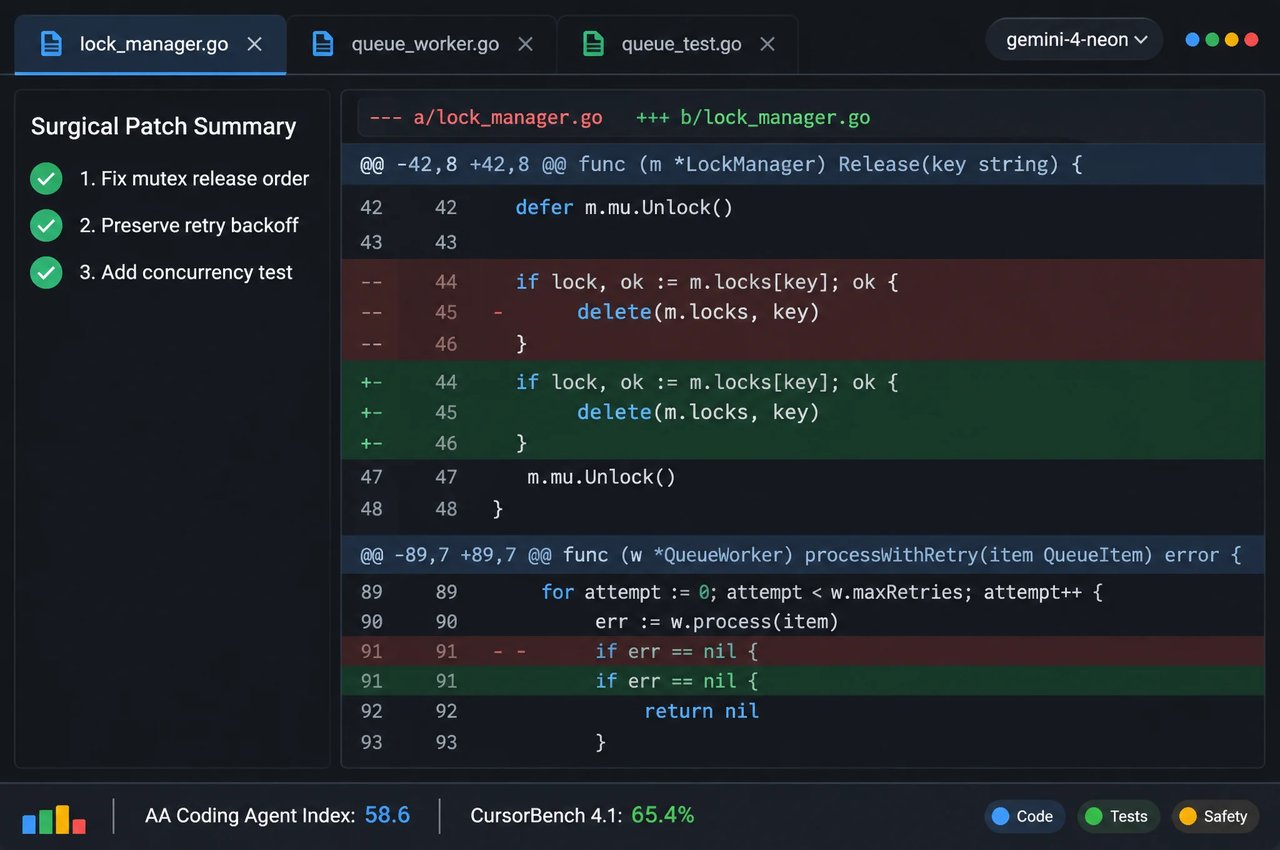
Google engineered Gemini 4 Neon for multi-file debugging and refactoring across codebases with targeted, surgical edits, fewer redundant file reads and reliable context compaction across long sessions. Google reports #1 on the Artificial Analysis Coding Agent Index (58.6), 65.4% on CursorBench 4.1, 65.2% on Terminal-Bench 4.1 and 46.2% on FrontierCode 2.0 at its default high setting.
Four Thinking Levels From Low to Xhigh
03

Four Thinking Levels From Low to Xhigh

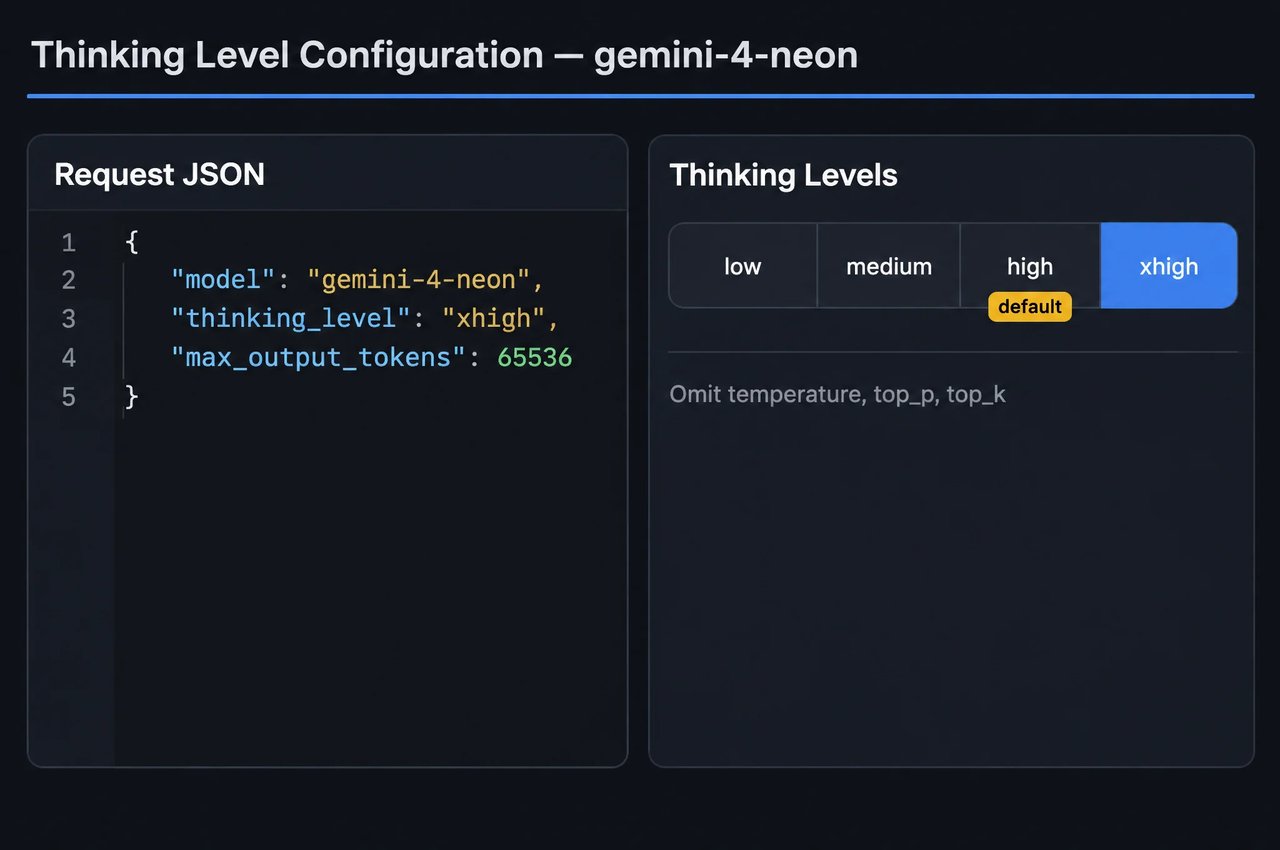
Control reasoning depth and token use across four thinking levels: low, medium, high (the default in Google's Gemini API) and xhigh; setting minimal returns an error. Google recommends starting with high for complex coding, tool calling and multimodal knowledge work, and reserving xhigh for hard multi-step engineering, analytical and scientific problems.
Unified 1M-Token Multimodal Context Window
04

Unified 1M-Token Multimodal Context Window

Input, thinking and output tokens share one 1,048,576-token context window, with up to 65,536 output tokens per synchronous response by default. Pass text, images, video, audio and PDFs in a single request to synthesize spreadsheets, contracts, dense charts and recorded meetings into structured text outputs, backed by 95.2% on GraphWalks (256K to 1M) and 89.0% on LVBench.
Analytical, Legal and Scientific Workflows
05

Analytical, Legal and Scientific Workflows

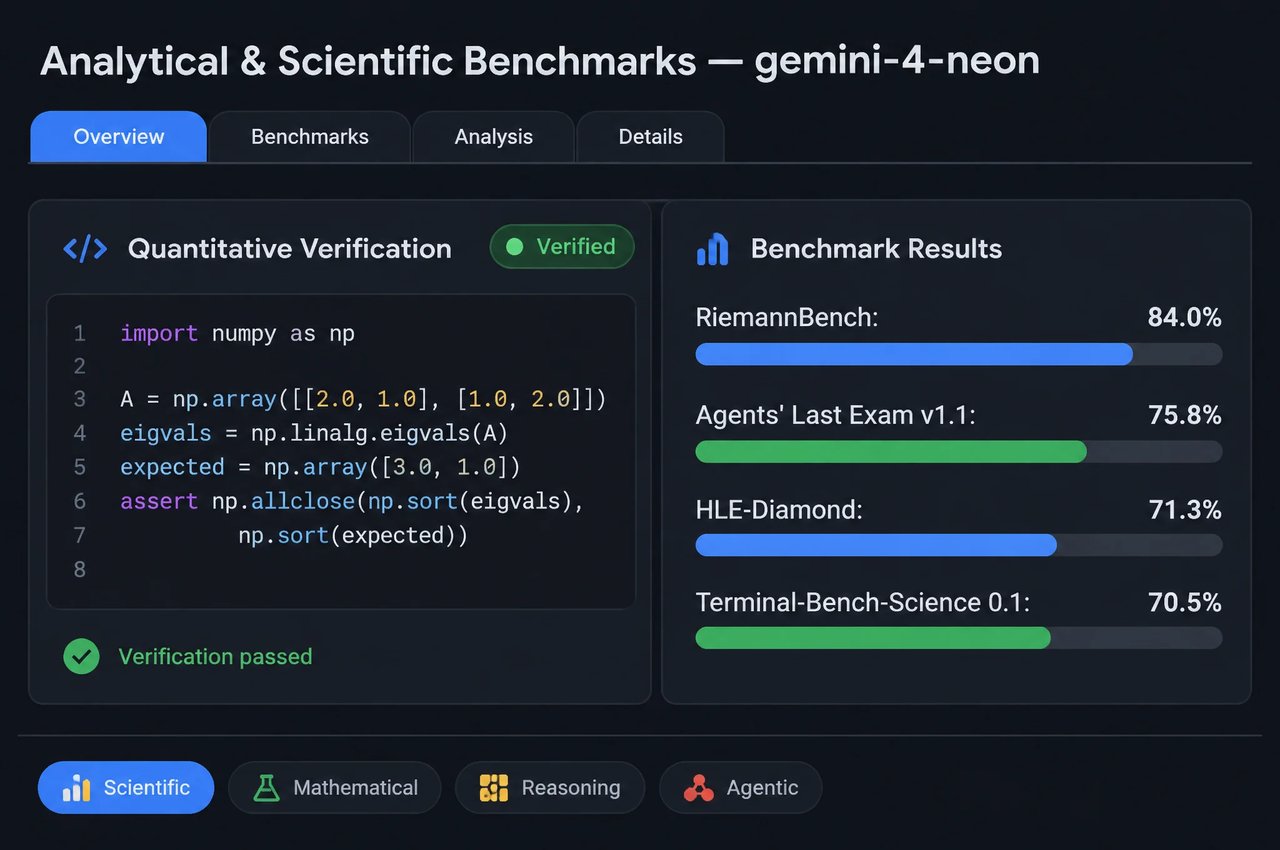
Google reports #1 placements on Legal Research Bench, Tax Agent Bench and Zapier's AutomationBench (56.3%), alongside 75.8% on Agents' Last Exam v1.1 and 73.5% on Chartography. On mathematics and scientific reasoning, Neon reaches 84.0% on RiemannBench, 71.3% on HLE-Diamond and 70.5% on Terminal-Bench-Science 0.1.
Secure Code Generation, Grounding and Tools
06

Secure Code Generation, Grounding and Tools

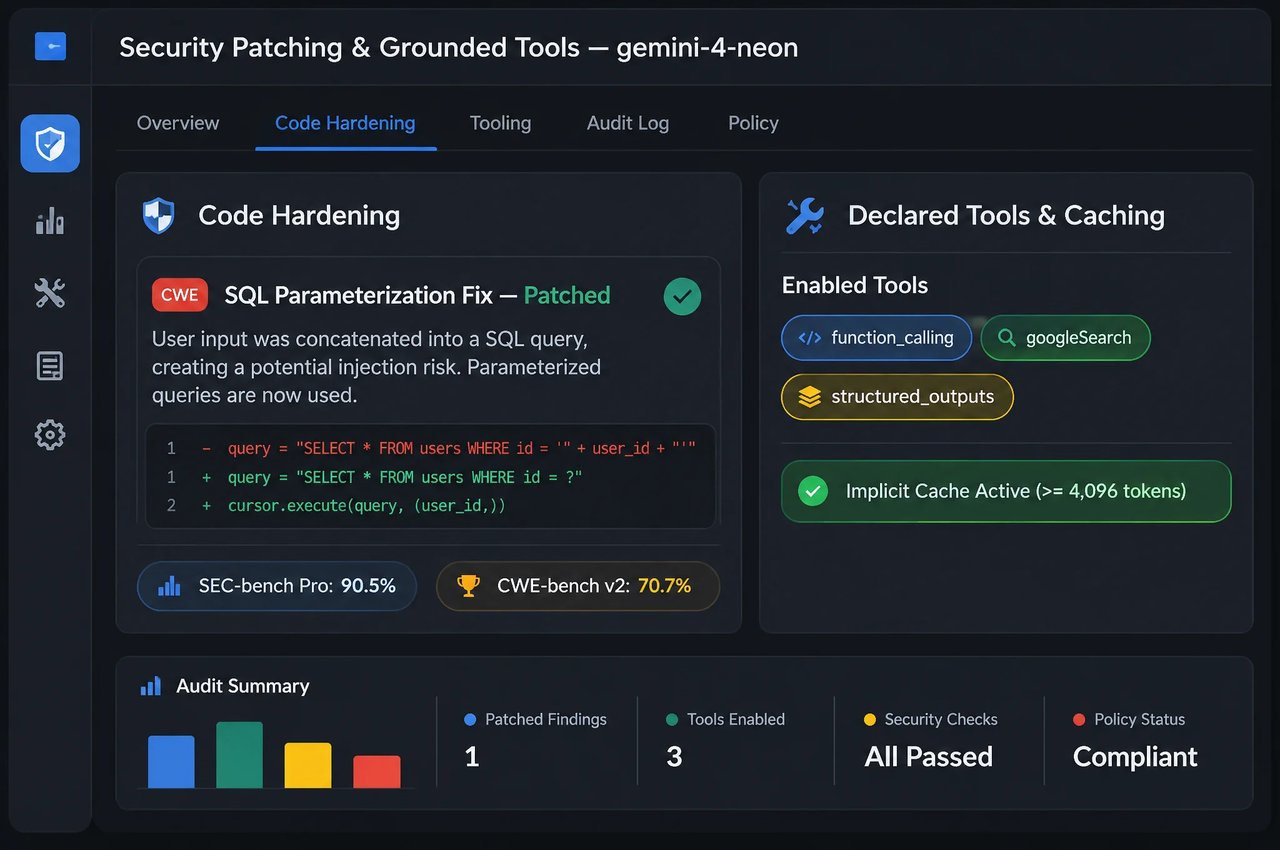
Gemini 4 Neon generates more secure code than Gemini 4 Carbon across easy, medium and hard challenges on AutoBaxBench (76% on the hard tier), scores 90.5% on SEC-bench Pro and reaches 70.7% on CWE-bench v2. In Google's Gemini API, it supports native function calling, structured outputs, Grounding with Google Search and automatic implicit context caching on prompts of at least 4,096 tokens.
SpecificationGemini 4 Neon
DeveloperGoogle (Google DeepMind)
Model ID (Google)gemini-4-neon
Release dateNovember 18, 2026
Adapted fromGemini 4 Carbon
ModalitiesText, image, video, audio and PDF input; text output (image and audio generation unsupported)
Context window1,048,576 tokens unified across input, thinking and output
Max output tokensUp to 65,536 tokens per synchronous response by default (Google model card)
Thinking levelslow, medium, high (default in Google's API), xhigh (minimal rejected)
Sampling parametersOmit temperature, top_p and top_k (in-range custom values ignored; out-of-range values return HTTP 400 in Google's API)
Documented API capabilitiesStreaming, function calling, structured outputs, Google Search grounding, implicit context caching (explicit cachedContents unsupported)
Knowledge cutoffMarch 2026
BenchmarkGemini 4 NeonWhat It Measures
AA Intelligence Index v5.0.161 (#3 overall, at xhigh)General capability index
Vals Index v2.270.9% (#2 overall; #1 Legal Research & Tax Agent)Enterprise, legal and tax evaluations
AA Coding Agent Index58.6 (#1 overall)Agentic software engineering
CursorBench 4.1 / Terminal-Bench 4.165.4% / 65.2% (cheating-adjusted)Repository coding and terminal execution
FrontierCode 2.0 / SWE-sweep46.2% (at high) / 39.0% (Antigravity harness), 12.8% (mini-SWE)Software engineering benchmarks
Agents' Last Exam v1.1 / AutomationBench75.8% / 56.3% (#1 overall)Multi-step knowledge work and workflow automation
RiemannBench / HLE-Diamond / Terminal-Bench-Science 0.184.0% / 71.3% / 70.5%Mathematics and scientific reasoning
GraphWalks (256K to 1M, BFS F1)95.2%Long-context retrieval and reasoning
LVBench / Chartography / MKA89.0% / 73.5% / 56.5%Long video, dense charts and multimodal reasoning
SEC-bench Pro / CWE-bench v2 / WebExploitBench v1.290.5% / 70.7% / 51.3%Vulnerability detection, patching and web security

How to Work With Gemini 4 Neon

Four practices from Google's Gemini 4 developer documentation that govern model selection, thinking budgets, schemas and caching.
  1. 1

    Step 1: Choose Between Hydrogen, Neon and Carbon

    Use Gemini 4 Neon for complex software engineering, analytical reasoning and science workflows where you want frontier-level quality with efficient task completion. Keep Gemini 4 Hydrogen for fast everyday coding and chat, and reserve Gemini 4 Carbon for your hardest long-horizon architecture and research problems.
  2. 2

    Step 2: Start at High and Reserve Xhigh for Hard Problems

    High is the default thinking level in Google's Gemini API. Drop to medium or low for interactive coding and latency-sensitive requests, and reserve xhigh for hard multi-step engineering, analytical or scientific problems where high falls short. Omit temperature, top_p and top_k, and do not set minimal.
  3. 3

    Step 3: Leave Room for Thinking and Output Tokens

    Because input, thinking and output tokens share the 1,048,576-token window and max_output_tokens caps combined thinking plus output tokens, Google recommends removing hardcoded low caps such as 8,192 and keeping up to 65,536 tokens available for synchronous responses so answers are not truncated.
  4. 4

    Step 4: Declare Native Tools and Keep Prefixes Stable

    Declare native function tools when you want the model to call tools; prompting for raw-text JSON tool calls through system instructions with zero declared tools can trigger MALFORMED_FUNCTION_CALL. For structured JSON responses, use structured outputs. Keep shared prompt prefixes unchanged on inputs of at least 4,096 tokens to qualify for automatic implicit caching, and omit explicit cached_content fields.

What You Can Build With Gemini 4 Neon

Typical workloads suited to Google's 1M-context reasoning model.

Multi-File Debugging and Codebase Refactoring

Diagnose cross-module bugs, review pull requests and generate targeted multi-file edits across large codebases without rewriting unrelated files.

Legal, Tax and Financial Document Synthesis

Synthesize contracts, regulatory filings, billing statements, spreadsheets, charts and recorded meetings inside one 1M-token prompt into structured reports or JSON.

Scientific and Quantitative Analysis

Work through mathematical proofs, quantitative modeling, experiment design and technical research problems with configurable high or xhigh reasoning.

Defensive Code Review and Vulnerability Patching

Generate secure code from the start, audit repositories for security flaws and draft root-cause CWE fixes that preserve intended behavior.

Gemini 4 Neon on Kie.ai

01

Gemini 4 Neon API on Kie.ai

Kie.ai is adding Gemini 4 Neon to its chat models. This page serves as the reference for Google's documented capabilities, specifications and benchmarks ahead of launch.
03

One Key Across the Kie.ai Market

All models in the Kie.ai market use the same authentication method: an Authorization: Bearer YOUR_API_KEY header with the key from your Kie.ai API Key Management page.
04

One Credit Balance

Your account has one credit balance that all models in the Kie.ai market draw from, and you can check it programmatically with the Get Remaining Credits API.

Frequently Asked Questions

What is Gemini 4 Neon?

Gemini 4 Neon (gemini-4-neon) is Google's Gemini 4 model for complex software engineering, analytical reasoning, knowledge work and science workflows, released on November 18, 2026 and adapted from Gemini 4 Carbon.

How does Gemini 4 Neon compare with Gemini 4 Hydrogen and Gemini 4 Carbon?

Google positions Gemini 4 Neon between Gemini 4 Hydrogen and Gemini 4 Carbon. Hydrogen handles fast everyday coding and execution, Carbon tackles the hardest long-horizon projects, and Neon balances frontier-level reasoning depth with efficient end-to-end task completion.

What are the context window and output token limits of Gemini 4 Neon?

Gemini 4 Neon features a unified 1,048,576-token context window shared across input, thinking and output tokens. Google's model card lists up to 65,536 output tokens per synchronous response by default, and a March 2026 knowledge cutoff.

What input and output modalities does Gemini 4 Neon support?

It accepts text, image, video, audio and PDF inputs and outputs text. Image generation, audio generation and the Live API are not supported.

Which thinking levels does Gemini 4 Neon support?

Gemini 4 Neon supports four thinking levels: low, medium, high (the default in Google's Gemini API) and xhigh. Setting thinking level to minimal returns an error, and Google advises omitting custom temperature, top_p and top_k values.

How does context caching work in Gemini 4 Neon?

Gemini 4 Neon uses automatic implicit context caching on prompts of at least 4,096 tokens and does not support explicit caching (cachedContents or caches.create). Keep shared prompt prefixes unchanged across requests so repeated context can match the cache.

Can Gemini 4 Neon use tools and Google Search grounding?

Yes. In Google's Gemini API, Gemini 4 Neon supports native function calling, structured outputs and Grounding with Google Search so responses can cite live web sources.

Is the Gemini 4 Neon API available on Kie.ai?

Not yet. Kie.ai is adding Gemini 4 Neon to its chat models. This page covers Google's documented capabilities, specifications and benchmarks for the model.