Check the Body, Not Only the Status
Errors such as 401 invalid API key, 402 insufficient credits or 429 rate limited can come back with HTTP status 200, so read the response body before treating a call as successful.
GPT-6 Luna and GPT-6 Sol are OpenAI GPT-6 models trained with methods similar to GPT-6 Astra, both available as API models on Kie.ai.
Automatically append previous messages to maintain multi-turn context. May increase token usage.
Automatically append previous messages to maintain multi-turn context. May increase token usage.
Complete guide to using GPT-6 Sol and Luna
GPT-6 Luna and GPT-6 Sol are OpenAI GPT-6 models trained with methods similar to GPT-6 Astra, which OpenAI describes as bringing Astra's advances to faster, more affordable models. GPT-6 Sol has since been upgraded to GPT-6.1 Sol. On Kie.ai, both GPT-6 Luna and GPT-6 Sol are available as API models.
New to GPT-6 Sol? Read what it is and how it compares →
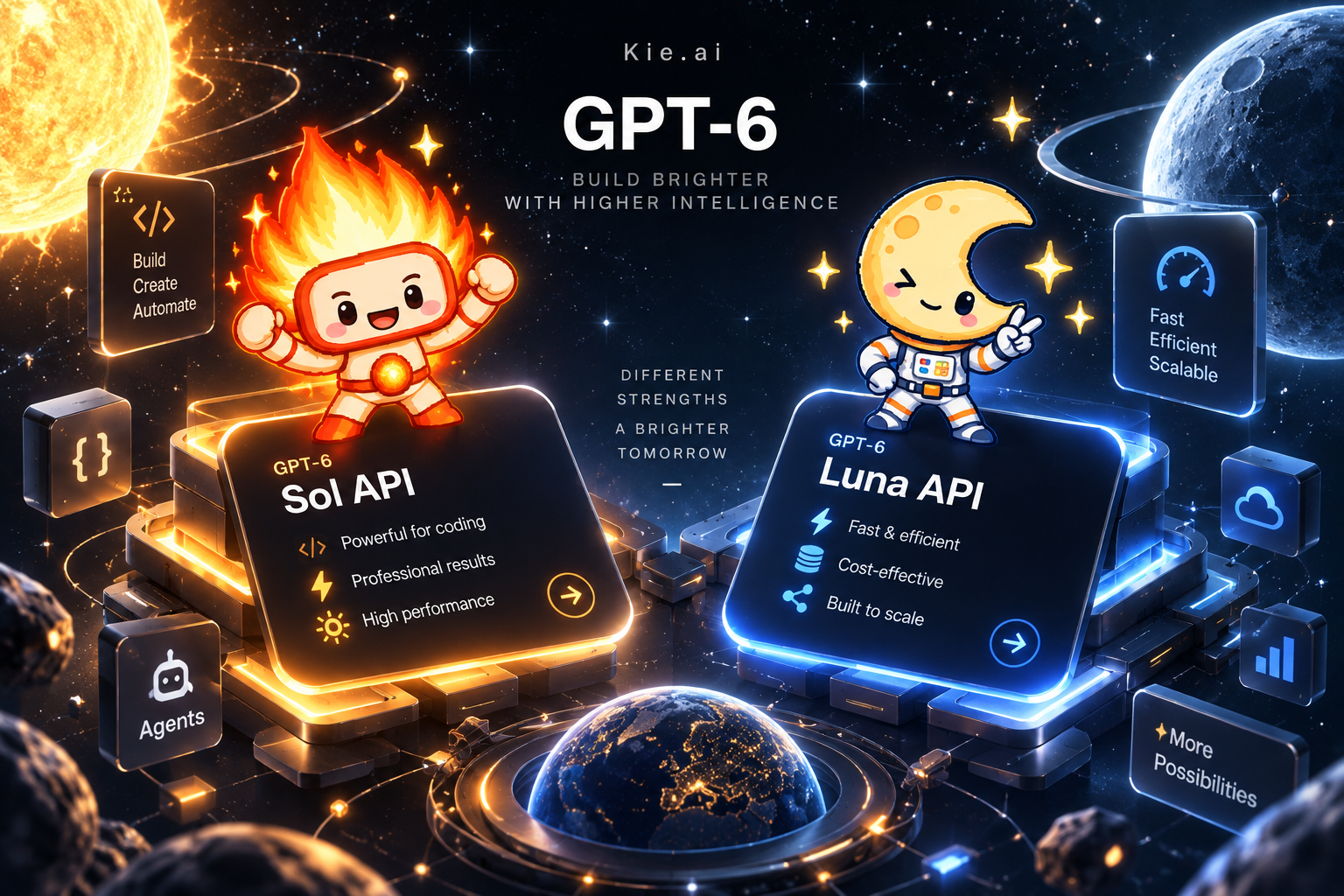
GPT-6 Luna and GPT-6 Sol take the same parameters on Kie.ai; only the model name changes.
| Parameter | Value |
|---|---|
| Models | gpt-6-luna, gpt-6-sol |
| Endpoint | POST /codex/v1/responses, compatible with the OpenAI Responses API |
| Context window | 1,050,000 tokens |
| Maximum input | 922,000 tokens |
| Maximum output | 128,000 tokens |
| Input types | Text, images and files, mixed in one message |
| Reasoning effort | low, medium, high, xhigh or max; default medium |
| Tools | Web search or function calling, not both in one request |
| Streaming | On by default (server-sent events); set stream to false for a single JSON response |
| Pricing | Shown in the pricing card above; select a model to see its price |
OpenAI calls GPT-6 Luna its most efficient model for focused, high-volume tasks, while GPT-6 Sol is built to take on difficult work tasks. On OpenAI's DeepSWE v1.1 coding benchmark at maximum reasoning effort, GPT-6 Sol scores 68.8% and GPT-6 Luna 66.6%, and LMArena's text leaderboard gives GPT-6 Sol 1456 and GPT-6 Luna 1443 (as of October 8, 2026). On Kie.ai, Luna costs less than Sol. A practical default is Luna for high-volume, focused requests and Sol for harder work tasks; GPT-6 Sol has since been upgraded to GPT-6.1 Sol, and OpenAI points to GPT-6 Astra for the most demanding work.
| GPT-6 Luna | GPT-6 Sol | |
|---|---|---|
| How OpenAI positions it | Its most efficient model for focused, high-volume tasks | Built to take on difficult work tasks |
| DeepSWE v1.1, max reasoning effort (OpenAI-reported) | 66.6% | 68.8% |
| LMArena text score (Oct 8, 2026) | 1443 | 1456 |
| Artificial Analysis Intelligence Index (Oct 2026) | 38 | Not listed |
| Newer version | — | Upgraded to GPT-6.1 Sol |
| Available on Kie.ai | Yes | Yes |
OpenAI trained GPT-6 Sol and Luna with methods similar to GPT-6 Astra and reports these improvements over their GPT-5.6 predecessors.
On AutomationBench, a test of business workflows across apps, GPT-6 Luna at high reasoning effort scores 5.4 points above its predecessor.
On OpenAI's factuality evaluation, built from real conversations where users flagged mistakes, GPT-6 Sol makes about half as many mistakes as its predecessor, and GPT-6 Luna also improves.
On FrontierCode, which checks whether coding agents produce changes ready to merge into real codebases, GPT-6 Sol improves substantially over GPT-5.6 Sol.
OpenAI brought GPT-6 Astra's communication style to Sol and Luna: more clarity, less jargon, fewer low-value details and slightly shorter answers.
These are the kinds of work each model fits, based on how OpenAI positions them.
Well-defined requests that run many times a day, where Luna's efficiency matters most.
Writing and fixing code in existing repositories, with Sol for the harder changes.
Multi-step tasks that move information between apps.
Complex professional workflows run by agents, where Sol takes on the difficult steps.
Errors such as 401 invalid API key, 402 insufficient credits or 429 rate limited can come back with HTTP status 200, so read the response body before treating a call as successful.
One request can use web search or your own function tools, not both. When you pass function tools, set tool_choice to auto; without function tools, leave tool_choice out.
All models in the Kie.ai market use the same authentication method: an Authorization: Bearer YOUR_API_KEY header with the key from your Kie.ai API Key Management page.
New Kie.ai users receive 80 free credits for testing. Your account has one credit balance that all generation services draw from, and you can check it with the Get Remaining Credits API.
Kie.ai provides this model as an API with a playground; there is no app to download or install. There are no GPUs or model weights to manage.