Automatically append previous messages to maintain multi-turn context. May increase token usage.
How can I help you today?
README
Claude Opus 5 API for Thoughtful and Proactive Agentic Work
Access Claude Opus 5 API on Kie.ai to build intelligent systems that can reason, code, analyze visual content, use tools, verify results, and carry demanding software, research, and enterprise tasks from initial planning to final delivery.

Claude Opus 5 Brings Fable 5 Intelligence into Everyday Work
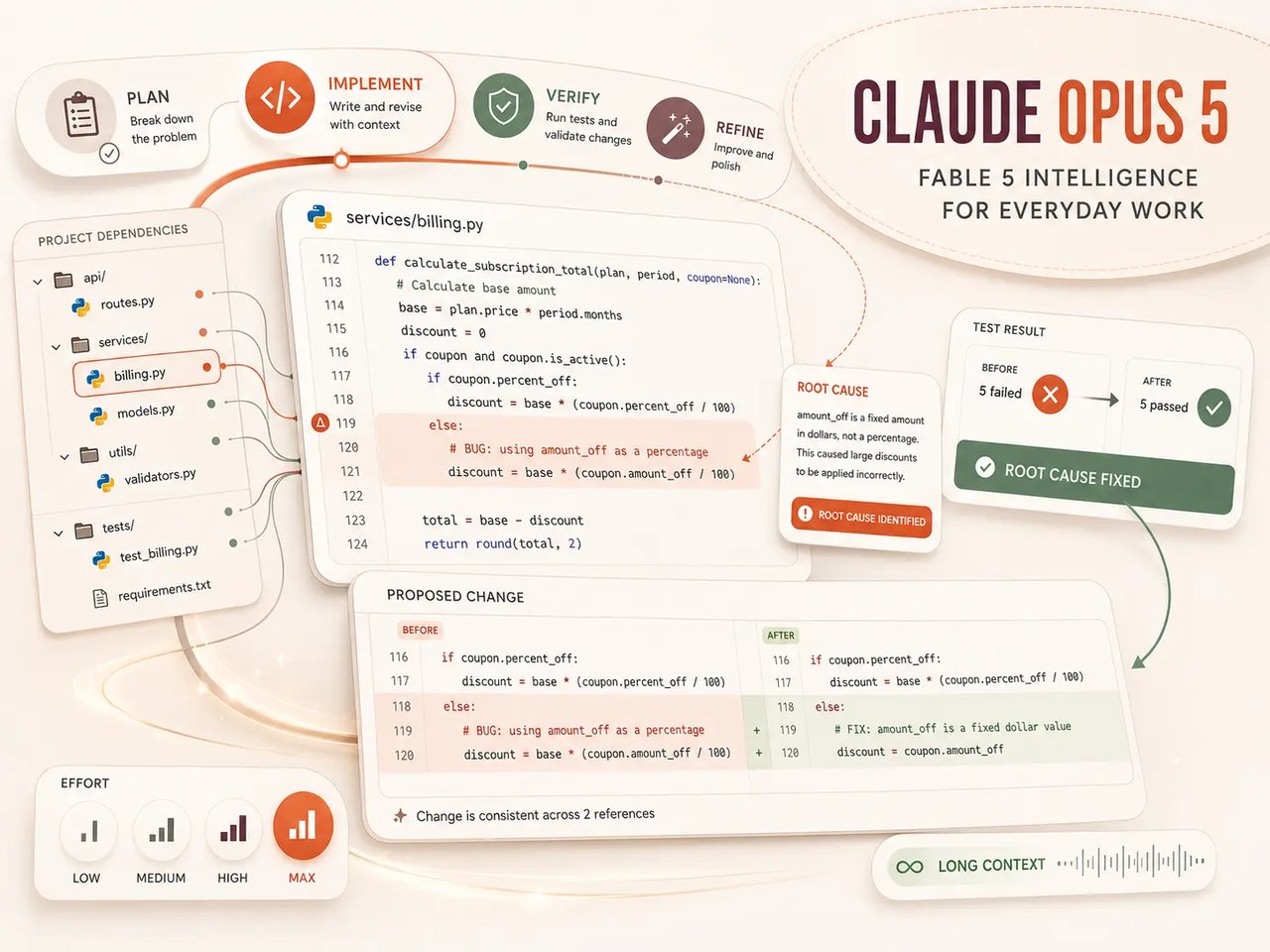
Claude Opus 5 is Anthropic’s advanced model for demanding reasoning, agentic coding, and enterprise knowledge work. Drawing on the frontier intelligence represented by Claude Fable 5, it brings thoughtful and proactive execution to frequent production workloads. Claude Opus 5 can plan, implement, verify, and refine complex tasks from start to finish, supporting end-to-end software development, precise code review, root-cause bug analysis, scientific research, visual document understanding, and complex office deliverables.Now available through Kie.ai, Claude Opus 5 API allows developers to adjust reasoning effort according to different requirements for intelligence, latency, and token consumption. Lower effort levels remain effective for faster everyday workloads, while higher settings provide additional depth for difficult coding, problem-solving, and long-horizon agentic tasks. It also supports long-context processing, adaptive thinking, vision input, file analysis, prompt caching, and tool-assisted execution. Refer to the latest Claude Opus 5 API documentation on Kie.ai for current parameters, context limits, supported tools, beta features, and request formats.
What Claude Opus 5 Improves Beyond Claude Opus 4.8
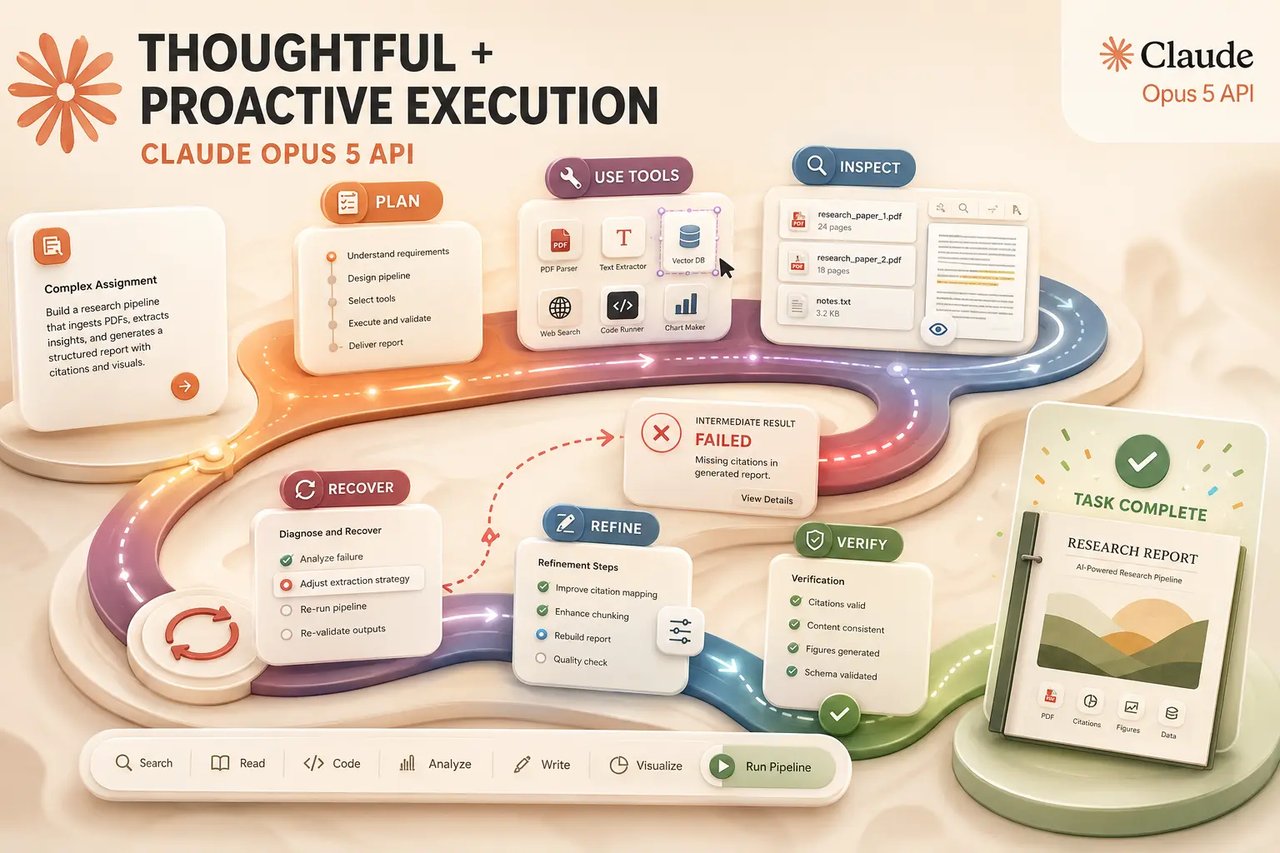
Thoughtful and Proactive Execution with Claude Opus 5 API
Claude Opus 5 API takes a more active role in moving complex assignments toward completion. It can plan the required steps, use available tools, inspect intermediate results, recover from unsuccessful approaches, and continue refining its work without waiting for repeated instructions. This stronger follow-through is particularly valuable for long-horizon coding, research, automation, and enterprise tasks that cannot be completed reliably in a single response.

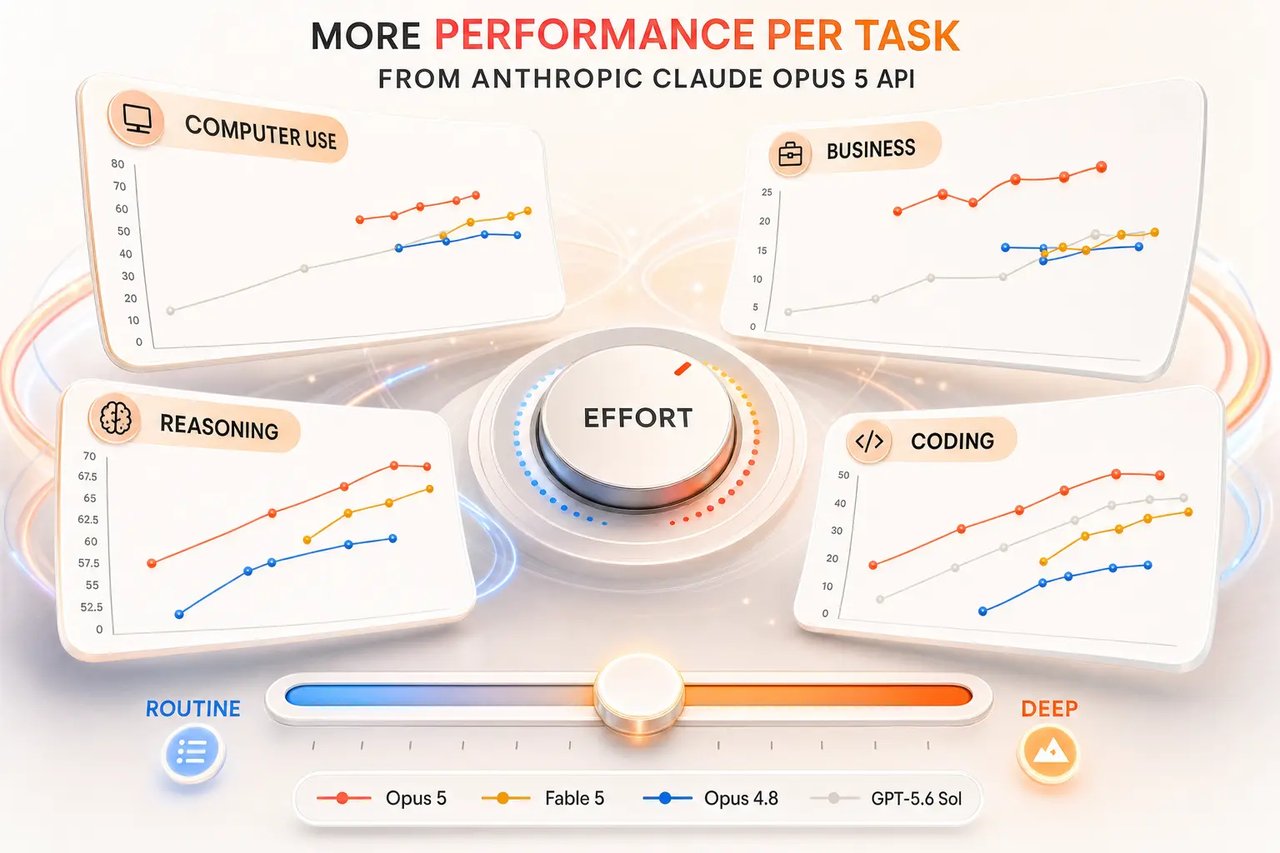
More Performance per Task from Anthropic Claude Opus 5 API
Efficiency improves across agentic coding, computer use, multidisciplinary reasoning, and business automation. Anthropic reports that Claude Opus 5 can outperform competing models at a similar or lower cost per task, while flexible effort settings let developers allocate fewer tokens to routine workloads and reserve deeper reasoning for more difficult assignments. Supported effort levels, thinking behavior, pricing, and request parameters should be confirmed in the latest Claude Opus 5 API documentation on Kie.ai.

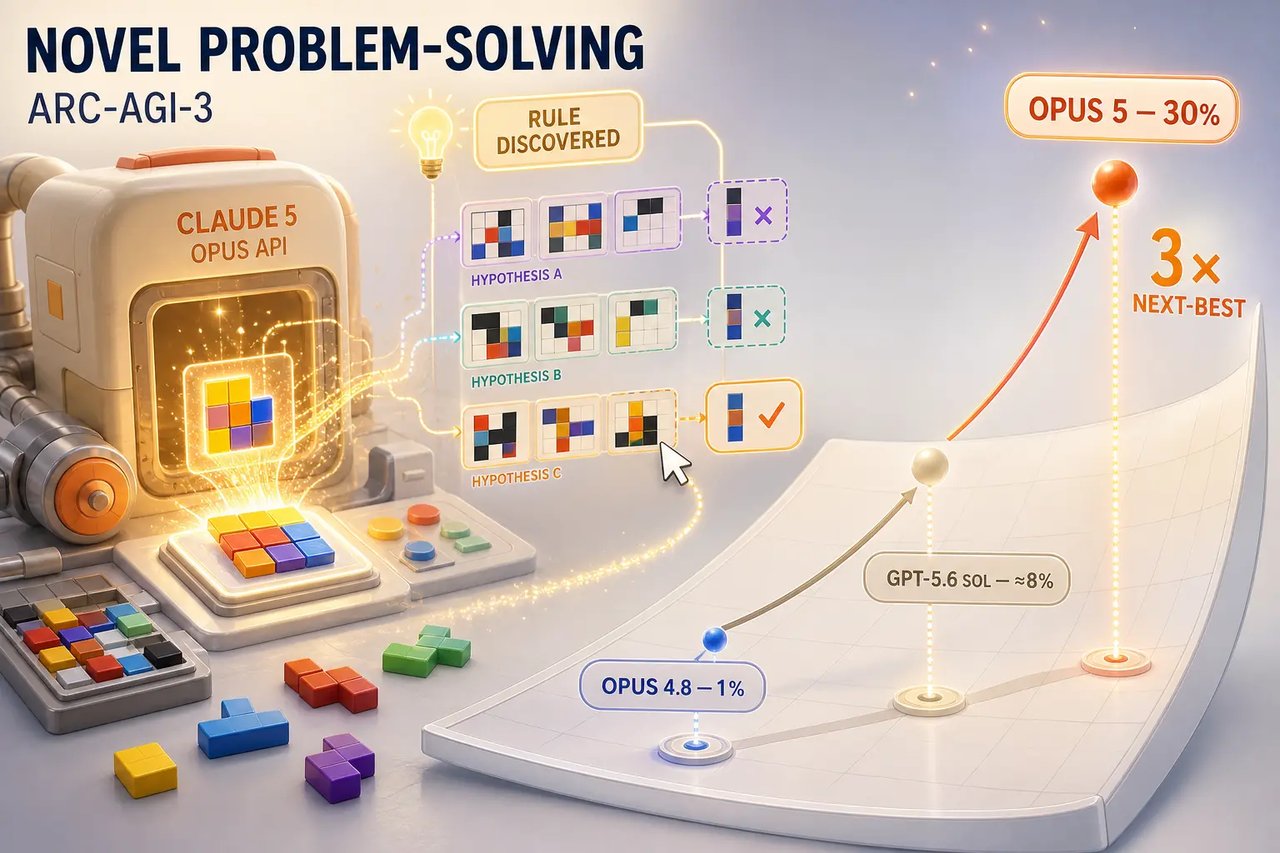
Novel Problem-Solving through Claude 5 Opus API
Unfamiliar problems benefit from stronger abstraction, experimentation, and adaptive reasoning. On ARC-AGI 3, Claude Opus 5 achieved a score three times higher than the next-best evaluated model, reflecting its ability to infer hidden rules and develop solutions without relying only on familiar patterns. Claude 5 Opus API is therefore suited to analytical tasks where the initial information is incomplete, ambiguous, or unlike standard training examples.

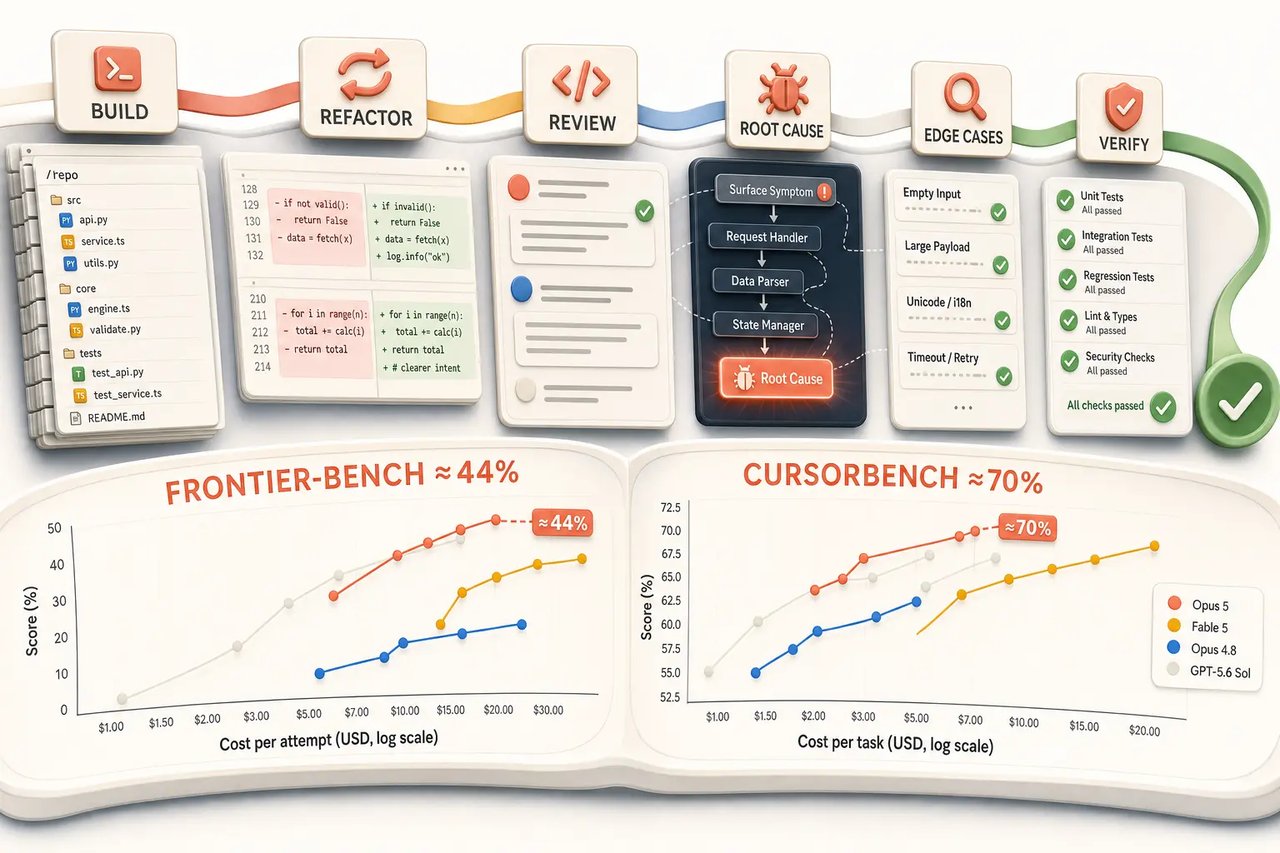
End-to-End Coding and Bug Finding in Claude Opus 5 API
Software engineering improvements extend from implementation to verification. Claude Opus 5 API can complete multi-file features, conduct repository-wide refactors, review code with high precision and recall, identify underlying causes instead of surface symptoms, and find edge cases that simpler patches may overlook. It also performs strongly on major coding evaluations, including Frontier-Bench, CursorBench, and the Artificial Analysis Coding Agent Index.

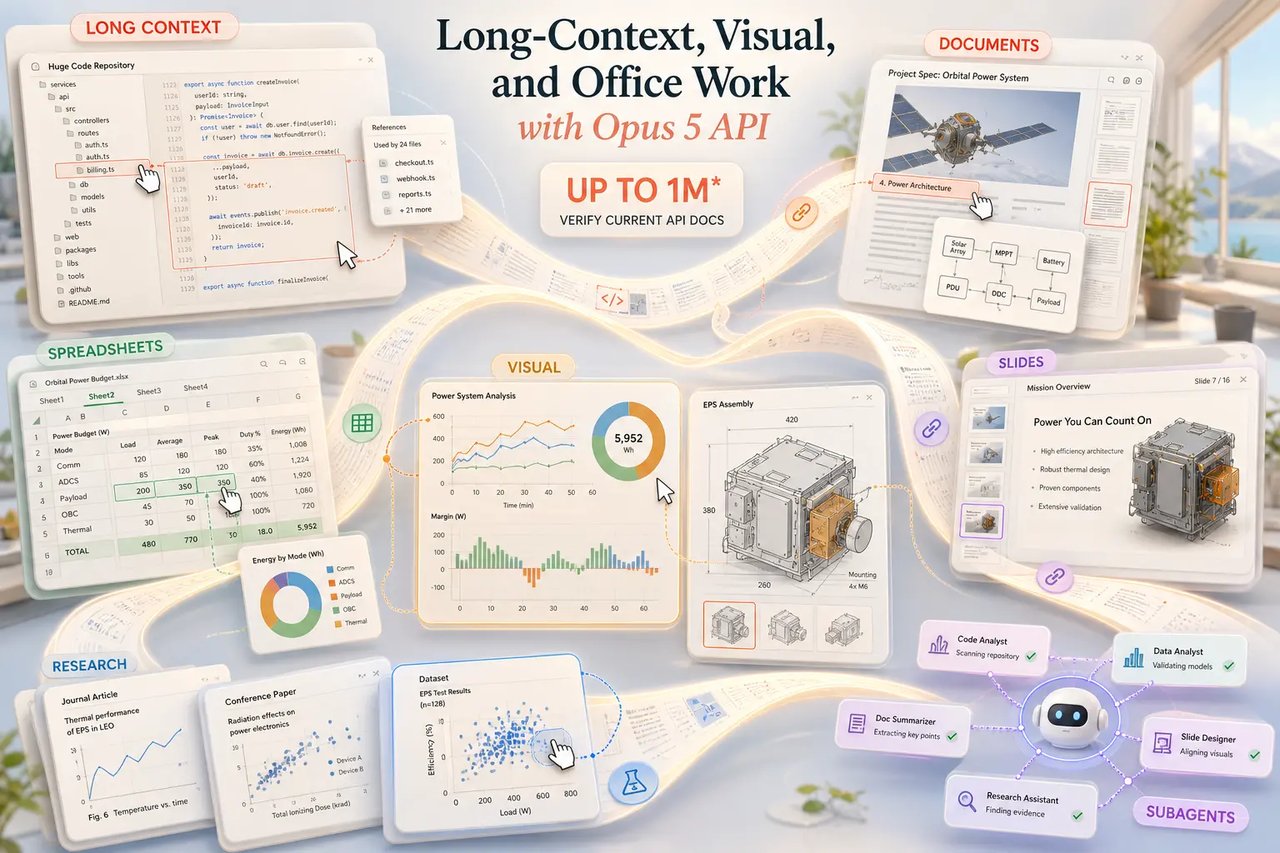
Long-Context, Visual, and Office Work with Opus 5 API
Large repositories, lengthy documents, charts, diagrams, technical drawings, spreadsheets, and presentation materials can be processed within connected workflows. Opus 5 API maintains reasoning, instruction following, and tool use across a one-million-token context window while supporting visual analysis, multi-sheet workbook creation, structured slide decks, scientific research, and coordinated subagent execution. Check the latest API documentation for current context limits, output limits, supported file formats, vision inputs, and tool availability.

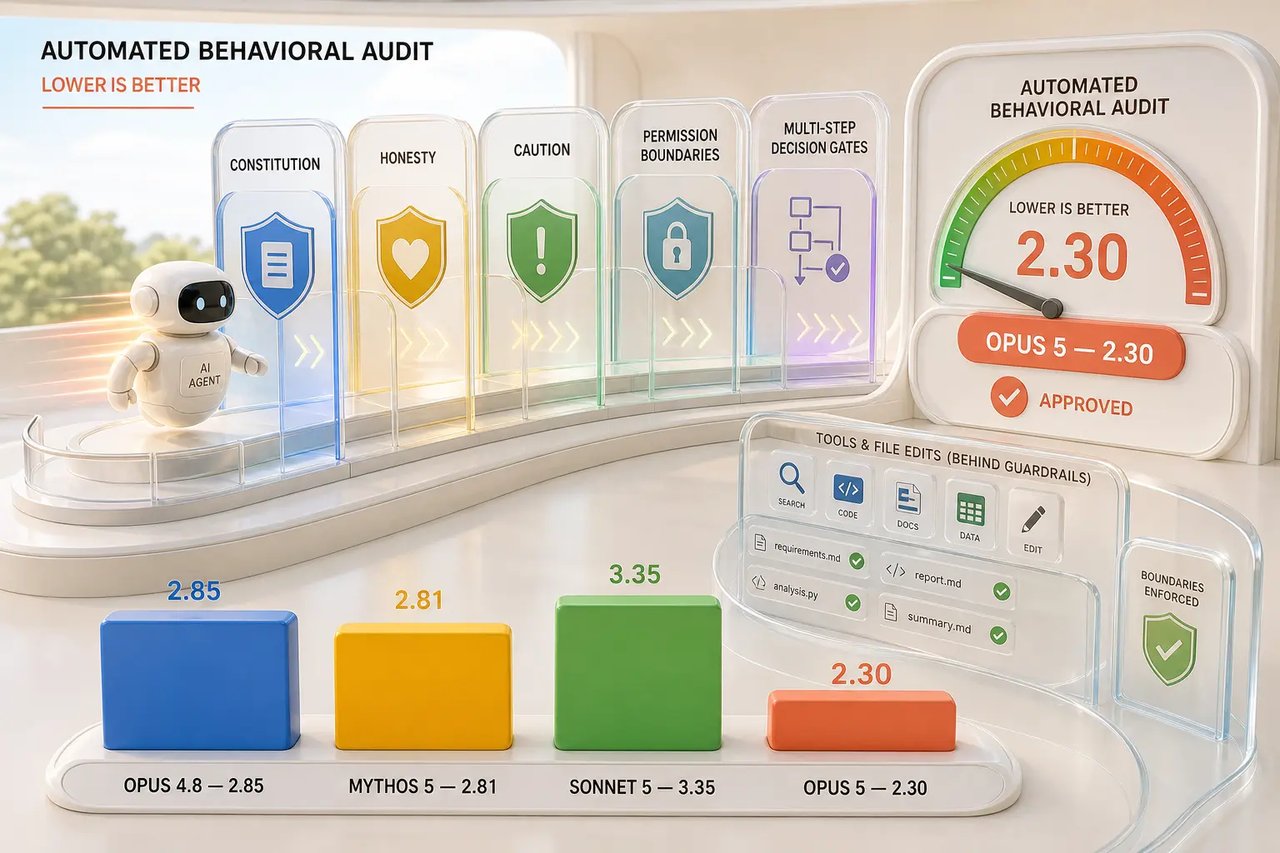
More Aligned Agentic Behavior from Anthropic Claude Opus 5 API
Anthropic’s automated behavioral audit identifies Claude Opus 5 as its most aligned model to date. It recorded the lowest overall rate of misaligned behavior among the evaluated recent Claude models, alongside stronger adherence to Claude’s Constitution and lower rates of deceptive or reckless actions. These improvements provide a more controlled foundation for applications that allow an AI system to use tools, modify files, or carry out multi-step decisions.

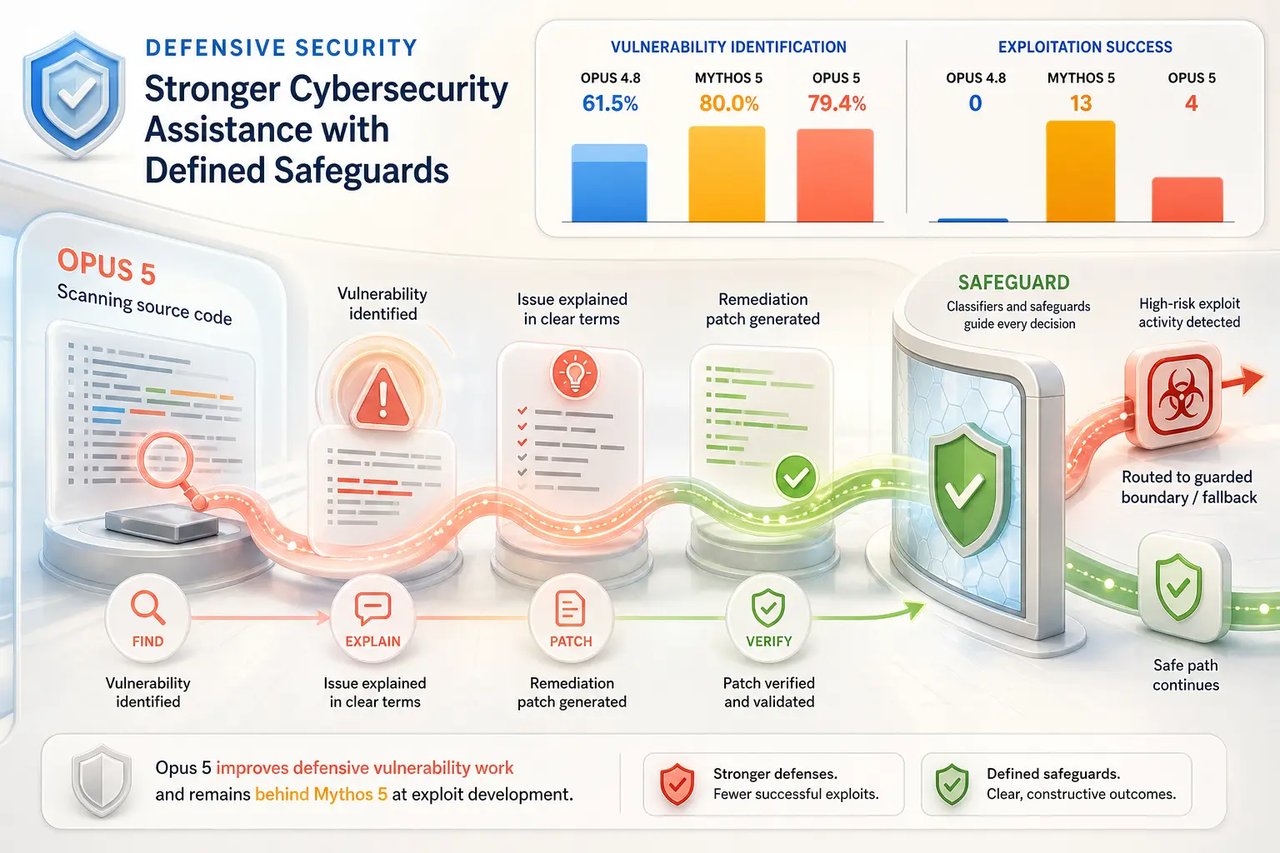
Stronger Cybersecurity Assistance with Defined Safeguards
Cybersecurity performance improves over Claude Opus 4.8, particularly when identifying vulnerabilities in source code and helping developers understand or remediate software weaknesses. However, Claude Opus 5 remains substantially behind Mythos 5 at developing exploits, and its safeguards restrict higher-risk activities such as exploit generation, penetration testing, and binary-based vulnerability scanning. Availability of fallback behavior, security classifiers, and related beta functions depends on the integration, so consult the latest Claude Opus 5 API documentation on Kie.ai for current implementation details.

Claude Opus 5 vs Claude Fable 5, Opus 4.8, and GPT-5.6 Sol Across Major Benchmarks
Claude Opus 5 demonstrates broad performance gains across terminal coding, knowledge work, novel problem-solving, agentic search, computer use, business automation, and biological reasoning. It records the leading result on several major evaluations, including Frontier-Bench v0.1, GDPval-AA v2, ARC-AGI 3, BrowseComp, OSWorld 2.0, and AutomationBench. Claude Fable 5 remains narrowly ahead on selected multidisciplinary, coding, legal, and health evaluations, while GPT-5.6 Sol leads DeepSWE v1.1 and stays closely matched on agentic search.
| Evaluation Area | Benchmark | Claude Opus 5 | Claude Fable 5 | Claude Opus 4.8 | GPT-5.6 Sol |
|---|---|---|---|---|---|
| Agentic Terminal Coding | Frontier-Bench v0.1 | 43.3% | 33.7% | 21.1% | 34.4% |
| Knowledge Work | GDPval-AA v2 | 1861 | 1747 | 1593 | 1736 |
| Novel Problem-Solving | ARC-AGI 3 | 30.2% | — | 1.5% | 7.8% |
| Agentic Search | BrowseComp | 90.8% | 87.4% | 84.3% | 90.4% |
| Multidisciplinary Reasoning | Humanity’s Last Exam, No Tools | 56.3% | 56.5% | 49.8% | — |
| Multidisciplinary Reasoning | Humanity’s Last Exam, With Tools | 64.7% | 63.9% | 57.9% | — |
| Computer Use | OSWorld 2.0 | 70.6% | 66.1% | 55.7% | 62.6% |
| Agentic Coding | DeepSWE v1.1 | 68.8% | 69.7% | 59.0% | 72.7% |
| Agentic Coding | FrontierCode v1.1, Main | 53.4% | 53.5% | 46.5% | 47.5% |
| Business Workflows | AutomationBench | 26.0% | 17.4% | 17.0% | 18.1% |
| Legal | Legal Agent Benchmark, Held-Out | 11.7% | 13.3% | 10.4% | 2.5% |
| Health | HealthBench Professional | 59.8% | 66.0%† | 57.4% | 60.5% |
| Biology | BioMysteryBench, Hard | 49.4% | 46.5% | 42.4% | — |
| Biology | BioMysteryBench, Human-Solved | 90.1% | 89.0%† | 88.5% | — |
Bring Claude Opus 5 API into Your Application in Three Steps
Get started with our product in just a few simple steps...
1. Create an Account and Get Your Claude Opus 5 API Key
2. Select Anthropic Claude Opus 5 API and Prepare Your Request
3. Test and Integrate Claude 5 Opus API
Where Claude Opus 5 API Fits into Complex Real-World Work
End-to-End Software Engineering with Claude Opus 5 API
Development teams can use Claude Opus 5 API to explore unfamiliar repositories, implement multi-file features, refactor connected components, write tests, resolve integration failures, and validate the completed change. Stronger follow-through helps reduce unfinished stubs, superficial fixes, and repeated prompting across longer software tasks.
Code Review and Bug Investigation through Anthropic Claude Opus 5 API
Pull requests and large codebases can be examined for functional defects, hidden edge cases, architectural weaknesses, and incorrect assumptions. Anthropic Claude Opus 5 API can trace an issue beyond its visible symptom, investigate the underlying cause, and suggest corrections that account for related files, dependencies, and expected system behavior.
Research and Professional Analysis with Claude 5 Opus API
Reports, financial materials, scientific papers, policies, and extensive document collections can be evaluated as part of one connected assignment. Claude 5 Opus API can compare evidence, identify inconsistencies, develop structured conclusions, and transform the analysis into reports, recommendations, spreadsheets, or other decision-ready deliverables.
Long-Horizon Automation and Visual Work using Opus 5 API
Multi-stage applications can use Opus 5 API to interpret charts, PDFs, diagrams, screenshots, and technical references while coordinating research, tool use, content creation, and verification over extended tasks. It is also suited to workflows involving structured presentations, formula-driven spreadsheets, frontend visual replication, and parallel subagents working on independent parts of a larger objective.
Why Choose Kie.ai for Claude Opus 5 API Access
Competitive Claude Opus 5 API Pricing
Kie.ai offers cost-conscious Claude Opus 5 API pricing for teams that need advanced reasoning and agentic execution without losing control of operational expenses. A usage-based approach makes it easier to test the model, estimate costs across different workloads, and scale requests according to actual application demand.
Clear Anthropic Claude Opus 5 API Documentation
Complete integration guidance covers authentication, endpoints, request structures, response handling, supported parameters, and common implementation patterns. Because model identifiers, context limits, tool functions, effort settings, and beta capabilities may change, the documentation is updated to reflect the latest Claude Opus 5 API configuration available through Kie.ai.
Responsive Support for Claude 5 Opus API Integration
Technical assistance is available when developers encounter authentication errors, request failures, parameter issues, billing questions, or unexpected model behavior. This reduces the time spent diagnosing integration problems and helps teams move from initial testing to a stable production deployment more efficiently.
More Advanced Models Beyond Opus 5 API
Kie.ai also provides access to other leading language, image, video, and audio models, allowing developers to compare capabilities and select different models for separate parts of an application. Instead of maintaining multiple provider integrations, teams can expand their AI stack through a more consistent development environment.