Automatically append previous messages to maintain multi-turn context. May increase token usage.
How can I help you today?
README
Complete guide to using gpt-6-1-sol
GPT 6.1 Sol API – Access OpenAI GPT 6.1 Sol on Kie AI
Build with OpenAI GPT 6.1 Sol on Kie AI for near-GPT-6 Astra performance across complex coding, computer use, and professional workflows, with lower-cost API access.
What Is GPT-6.1 Sol?
OpenAI GPT-6 Model with Near-Astra Capabilities at Lower Cost
GPT-6.1 Sol is an OpenAI GPT-6 model positioned between GPT-6 Astra and GPT-6 Luna, and an upgrade to GPT-6 Sol. It delivers near-Astra capabilities at lower API costs, with improvements across agentic coding, computer use, professional work, and factuality. With a 1,050,000-token context window and multiple reasoning effort levels, GPT-6.1 Sol is designed for complex AI agents, large codebases, long documents, and multi-step workflows.
Key Capabilities of GPT 6.1 Sol API on Kie AI
Near GPT-6 Astra Capabilities at Lower API Cost
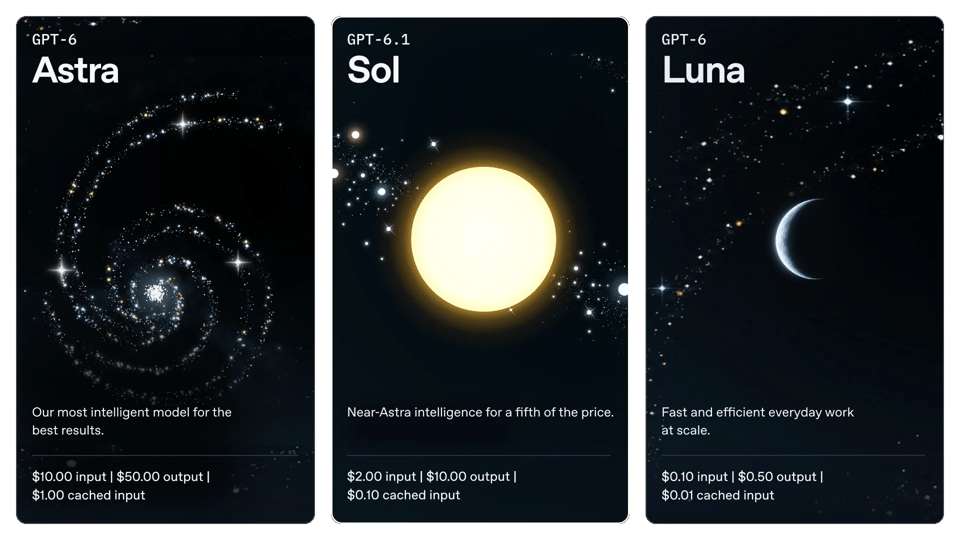
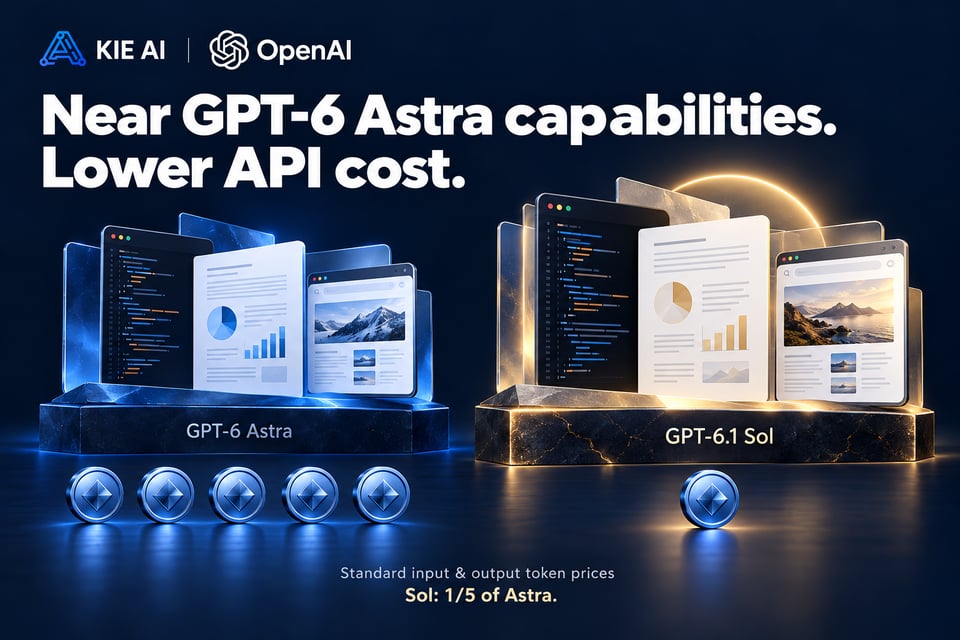
GPT 6.1 Sol is positioned between GPT-6 Astra and GPT-6 Luna, with a focus on balancing model capability and API cost. According to OpenAI, GPT 6.1 Sol approaches GPT-6 Astra performance in agentic coding, computer use, and professional work, while standard input and output token prices are one-fifth of Astra's.
Advanced Agentic Coding with GPT 6.1 Sol API
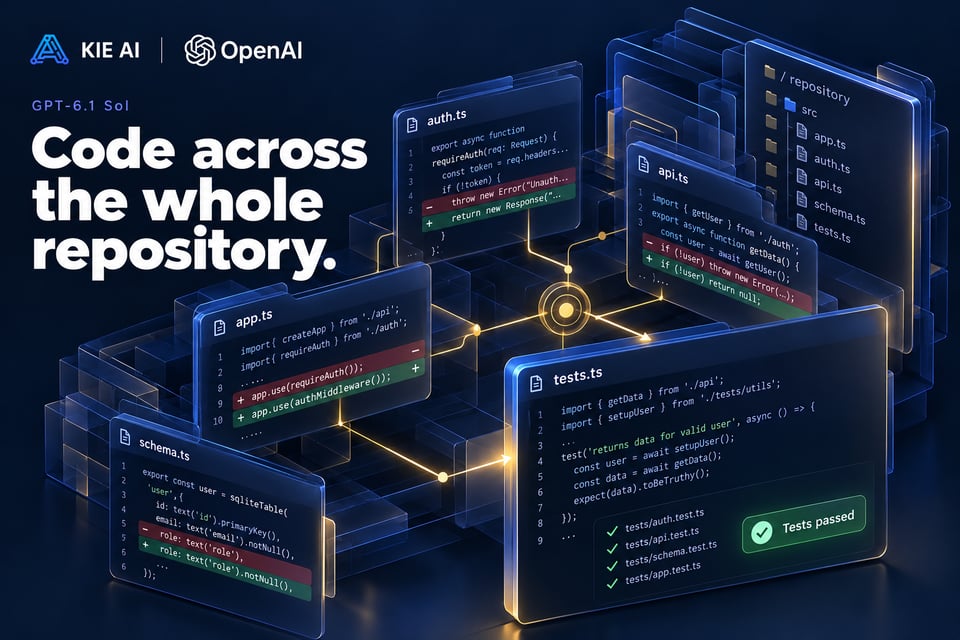
GPT 6.1 Sol API supports software engineering tasks across large and complex codebases, including code generation, debugging, refactoring, issue tracing, and repository-level changes. On DeepSWE v1.1, OpenAI reports that GPT 6.1 Sol matches GPT-6 Astra while improving on GPT-6 Sol's best score by 6.4 percentage points.
Long-Horizon AI Agents with OpenAI GPT 6.1 Sol API
OpenAI GPT 6.1 Sol API can be used for multi-step agent workflows involving reasoning, tool use, and sequences of dependent actions. These capabilities support applications such as AI agents, workflow automation, and developer tools that need to maintain context and complete tasks across multiple steps.

1M+ Token Context with GPT-6.1 API
GPT-6.1 API supports a context window of up to 1,050,000 tokens and maximum output of up to 128,000 tokens. This allows GPT 6.1 Sol to process large codebases, long documents, research materials, and other context-heavy inputs within a single workflow.

Professional and Computer-Use Workflows with GPT 6.1 Sol
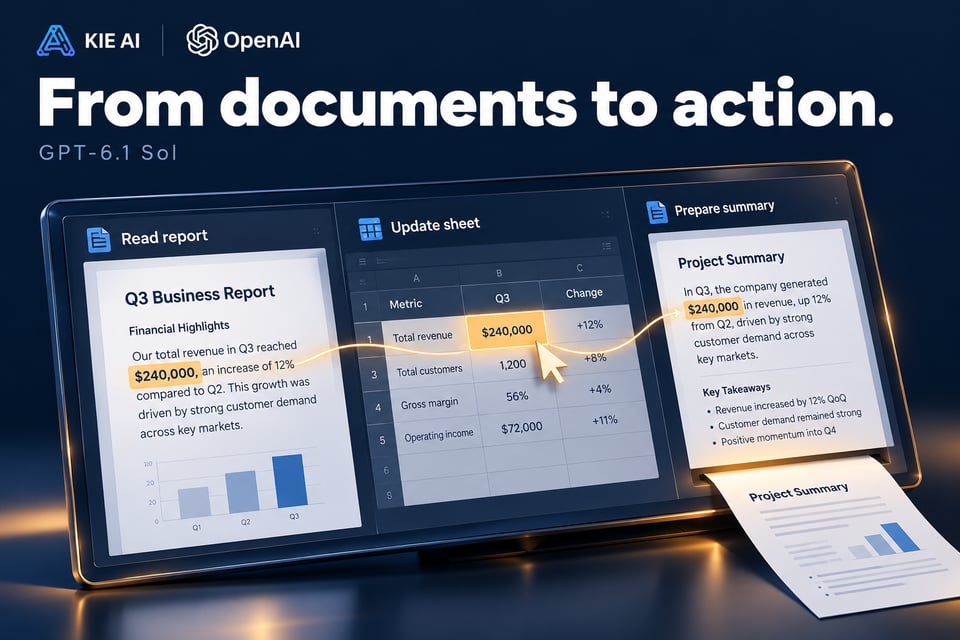
GPT 6.1 Sol supports professional tasks that involve document understanding, multi-step business processes, and interaction with computer applications. OpenAI reports improvements over GPT-6 Sol on both AutomationBench and OSWorld 2.0, covering business automation and computer-use workflows.
Improved Factuality Across Reasoning Tasks
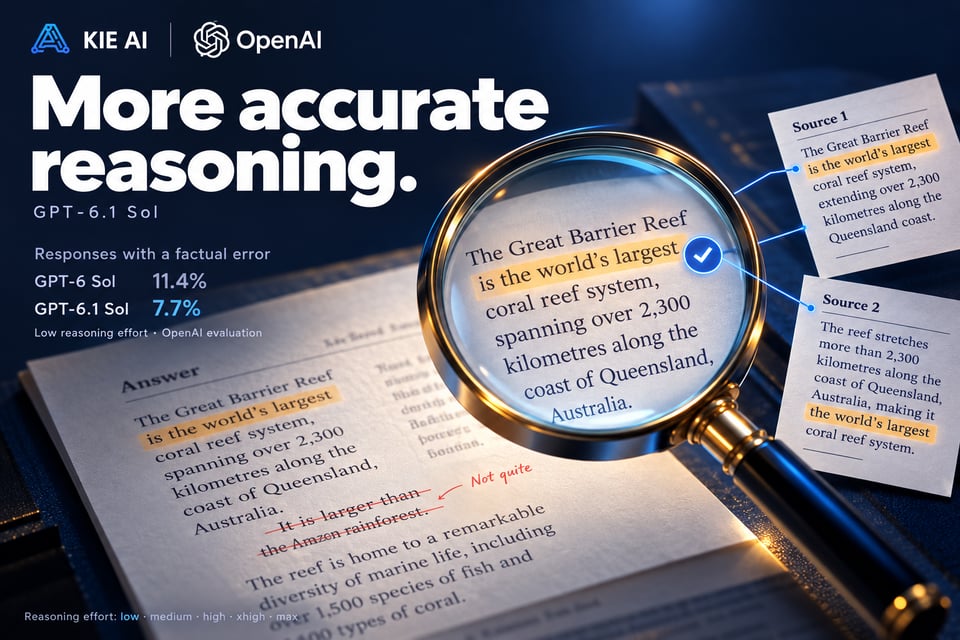
GPT 6.1 Sol shows improved factual accuracy over GPT-6 Sol in OpenAI's evaluation of difficult, error-inducing prompts. At low reasoning effort, responses containing at least one factual error decreased from 11.4% with GPT-6 Sol to 7.7% with GPT 6.1 Sol. GPT 6.1 Sol supports low, medium, high, xhigh, and max reasoning effort for different workload requirements.
GPT 6.1 Sol API Performance and Benchmarks
OpenAI reports improvements for GPT 6.1 Sol API across agentic coding, business automation, computer use, and factuality. GPT 6.1 Sol also approaches GPT-6 Astra on several agentic evaluations while running at a lower reported cost per task.
| Benchmark | What It Measures | GPT 6.1 Sol Result | Key Comparison |
|---|---|---|---|
| DeepSWE v1.1 | Agentic coding and long-horizon software engineering | Matches GPT-6 Astra | 6.4 percentage points above GPT-6 Sol's best score, at lower reasoning effort and cost |
| AutomationBench | Multi-step business automation | Improved over GPT-6 Sol | 4.8 points above GPT-6 Sol and 2.2 points above Claude Opus 5.5 at medium reasoning effort |
| OSWorld 2.0 | Computer-use and application workflows | Near GPT-6 Astra | Within 2.1 points of GPT-6 Astra at maximum reasoning effort, at roughly one-seventh of the cost per task |
| Factuality Evaluation | Factual accuracy on difficult prompts | 7.7% of responses contained a factual error at low reasoning effort | Down from 11.4% with GPT-6 Sol, an approximately 32% reduction |
| These results show where OpenAI GPT 6.1 Sol API has changed most compared with GPT-6 Sol. Benchmark results reflect OpenAI's reported evaluation settings and should be considered alongside application-specific testing when evaluating GPT 6.1 Sol for production workloads. |
How to Get Access to GPT 6.1 Sol API on Kie AI
Step 1 – Get Your Kie AI API Key
Step 2 – Try GPT 6.1 Sol Free in the Playground
Step 3 – Configure Your GPT 6.1 Sol API Request
Step 4 – Integrate GPT-6.1 API into Your Application
GPT 6.1 Sol vs GPT-6 Astra vs GPT-6 Luna
GPT-6 Astra for Frontier-Level Intelligence
GPT-6 Astra is the highest-capability model in the GPT-6 family. It is designed for workloads where model capability is the primary requirement, including difficult scientific research, complex reasoning, advanced coding, and other demanding tasks. Astra has higher standard API pricing than GPT 6.1 Sol and GPT-6 Luna.
GPT 6.1 Sol for Capability and Cost Balance
GPT 6.1 Sol is positioned between Astra and Luna. According to OpenAI, GPT 6.1 Sol approaches GPT-6 Astra performance in agentic coding, computer use, and professional work while standard input and output token prices are one-fifth of Astra's. It targets workloads that need stronger reasoning and agentic capabilities without moving to Astra pricing.
GPT-6 Luna for Fast, Efficient Work at Scale
GPT-6 Luna is the smaller and lower-cost model in the GPT-6 family. It focuses on fast, efficient processing for everyday and high-volume workloads where lower latency and API cost matter more than maximum reasoning capability.
GPT-6.1 Sol API vs Claude Sonnet 5.5 API
Compare GPT-6.1 Sol and Claude Sonnet 5.5
GPT-6.1 Sol API focuses on complex coding, computer use, professional work, and long-running agents, with a 1,050,000-token context window and configurable reasoning levels. Claude Sonnet 5.5 API emphasizes fast everyday coding, well-scoped agents, and knowledge work, with adaptive thinking and strong professional workflow support. Both APIs support long-context and tool-based agentic applications.
Access GPT-6.1 Sol API and Claude Sonnet 5.5 API on Kie AI
Kie AI provides access to both GPT-6.1 Sol API and Claude Sonnet 5.5 API with flexible, affordable pricing. Developers can test both models and select an API based on coding, AI agents, context requirements, and application workloads.
Why Use GPT 6.1 Sol API on Kie AI
Access OpenAI GPT 6.1 Sol Through One API
Access OpenAI GPT 6.1 Sol API through Kie AI and integrate the model into AI agents, developer tools, SaaS products, and other applications. Kie AI provides a unified API for GPT 6.1 Sol and other supported AI models, so developers can work with multiple models through one platform.
Try GPT 6.1 Sol Free with New-User Credits
New users receive free credits to test GPT 6.1 Sol on Kie AI before integrating the API. Use these credits to explore model outputs, test prompts, and evaluate GPT 6.1 Sol for your application. Credit usage depends on selected model settings and request parameters.
Test GPT-6.1 API in an Online Playground
Use Kie AI Playground to test GPT-6.1 API online before writing integration code. Developers can experiment with prompts, review responses, and adjust available settings in the browser, making it easier to evaluate GPT 6.1 Sol before moving to API integration.
Affordable GPT 6.1 Sol API with Flexible Pricing
Access GPT 6.1 Sol API on Kie AI with pricing designed for different usage levels, from initial API testing to larger production workloads. Flexible options let developers choose an approach based on request volume, project requirements, and budget without committing to more capacity than needed.
Access GPT-6 Astra, GPT 6.1 Sol, and GPT-6 Luna on Kie AI
Kie AI provides access to multiple models across the GPT-6 series, including GPT-6 Astra, GPT 6.1 Sol, and GPT-6 Luna. Developers can select models based on workload requirements such as capability, speed, and API cost while keeping model access within the same platform.
Get Developer Support for GPT 6.1 Sol API Integration
Get support when testing or integrating GPT 6.1 Sol API on Kie AI. The Kie AI support team can assist with API access, integration questions, usage issues, and other problems developers may encounter when moving from initial testing to production.
What Can You Build with OpenAI GPT 6.1 Sol API
AI Coding Assistants with GPT 6.1 Sol API
Build coding assistants and developer tools for code generation, debugging, refactoring, code review, and repository-level tasks. GPT 6.1 Sol API can support coding copilots and software engineering agents that work across multiple files and longer development workflows.
Autonomous AI Agents with GPT-6.1 API
Create AI agents that reason across multiple steps, use tools, process changing context, and complete sequences of actions. GPT-6.1 API can be used for task agents, workflow assistants, and other agentic applications that require more than a single prompt and response.
Business Automation SaaS with OpenAI GPT 6.1 Sol API
Build SaaS products that automate multi-step workflows across sales, operations, customer support, finance, and other business functions. OpenAI GPT 6.1 Sol API can process information, make task-level decisions, and coordinate actions across longer business workflows.
Long-Context Document Analysis Tools
Create applications that work with large PDFs, reports, contracts, financial documents, research materials, and other long-form content. With a context window of up to 1,050,000 tokens, GPT 6.1 Sol can process large amounts of information within document analysis and knowledge workflows.
Browser and Computer-Use AI Agents
Build AI agents for browser, desktop, and cross-application workflows with GPT 6.1 Sol API. These applications can combine model reasoning with computer-use tools to handle multi-step digital tasks across websites and software environments.
Research and Data Analysis Applications
Use GPT 6.1 Sol API for applications involving research, data analysis, simulation, technical problem-solving, and other reasoning-heavy workflows. Developers can combine the model with code and external tools to process data and support longer research tasks.